This is a very hard, complex question that obviously all the world’s books cannot answer. But I’ll try to write briefly from what I've understood through personal experience; obviously, that doesn’t give a complete answer, as God is so infinitely vast and great that we cannot even imagine. What is important is that our opinion and the idea of who He is go in the right direction, which is always accompanied and confirmed by His Word. There we discover the revelation of God to us, and there we can learn about Him. We must base our opinions and thoughts about Him on what we find there.
Often, the way many people, including us, imagine God may be incorrect because we have not yet reached a certain level of understanding. For the natural man, the one who doesn’t know God, this is normal. His knowledge of Him is superficial, mostly based on what he has heard about Him. The spiritual person who has been reborn and is now a new creation in Him is still the same. He doesn’t have complete knowledge of Him yet, as he will need to learn more throughout his entire life. Still, at least he has a foundation to build on. This is still a small but genuine part of God’s glory, revealed to him because one day he experienced repentance and truly came to know God’s forgiveness. The knowledge we're discussing is not just theological understanding, but the kind that the Holy Spirit teaches in our hearts. Once we have that, we can also enhance our knowledge from a theological perspective. Theological knowledge must always go hand in hand with spiritual knowledge.
Many people wonder why God works in a specific way, why He acts in such a way toward sin, and why He is holy and cannot bear sin. We add His judgments to the discussion, as there are often misunderstandings regarding this topic.
Let’s look at a verse in the First Letter to the Corinthians 14:33.
“For God is not the author of confusion but of peace, as in all the churches of the saints.”
And 1 Corinthians 14:40 says, “Let all things be done decently and in order.” In its context, this verse apparently speaks about an order in the churches regarding prophesying and speaking in tongues. And so it is. But the verse itself reveals the character of God and His nature. And there are other verses in the Bible speaking about the same topic. Therefore, here we can see the way He is.
If we look at creation and nature from the smallest to the greatest detail, we will notice that nothing is there by chance or arranged chaotically. Nature (the one undefiled and untouched by humans) has a specific order. Obviously, this nature bears the consequences of sin, but we can still see things working in a specific way there. Looking at the universe, we see that stars, planets, and solar systems are placed perfectly in a particular way.
It has nothing to do with an explosion or simply throwing everything into chaos. Someone with a mind having a design stands behind it. Even if we look at the smallest details, microscopically speaking, we will see molecules and other small particles arranged in order. This is also similar to how a solar system works—it explains that the same mind stands behind it.
Each molecule is composed of atoms that hold each other. The pictures above show our solar system and the structure of an atom. There are different kinds of atoms, but almost all of them are composed of neutrons and protons that form the nucleus and electrons that circle around the nucleus, similar to how planets do around the sun.
If I am not mistaken, there are cases where each electron has its own unique orbit, the same as the planets.
We can see a similarity here with atoms, which, in their structure, resemble a mini model of a solar system. I am not saying the atoms are small solar systems, but we see God’s genius design and creation by the way they are made. We see the same mind has created all of them, from the smallest to the greatest detail.
Looking at the chemical elements, it is the same. They also have an order. If I’m not mistaken, most chemical reactions, poisons, and harmful corrosive materials exist because man placed them out of their natural place and order. But all this and other wrong things are caused by another, greater disorder called sin. Looking at all creation, those who are truly gone in disorder are us, humankind. And obviously, this sin, this disorder, causes consequences for everything else.
“For the creation was subjected to futility, not willingly, but because of Him who subjected it in hope; because the creation itself also will be delivered from the bondage of corruption into the glorious liberty of the children of God.” (Romans 8:20-21)
God, in His nature, is the one who wants to fix this. He wants to fix everything. We sometimes cannot imagine what He can bear until He accomplishes it. We often cannot realize it, and we see things from our perspective, not being grateful enough. I don’t know if we will ever be in this life. I mean to be ever grateful enough, or be able to know and understand all the reasons for being grateful. Thanks to God for the reasons He already made us know. There is so much to be grateful for. I say this because, for God to fix what is wrong, He can simply remove it and rebuild something new. But what He did instead was in our favor.
“I will strike them with the pestilence and disinherit them, and I will make of you a nation greater and mightier than they.” (Numbers 14:12)
God said this to Moses about the nation of Israel, which kept sinning against God, but after he pleaded for mercy, He gave them another chance.
There is a balance in nature, the universe, and all creation. That balance confirms the character of their Creator. If I paint a picture and use a specific method or color, it will reveal my personality. It is because I like it, or because I have that personality. The same is true of God. The difference is that He is not a man like us. He doesn’t change His opinion.
He is not influenced by anything. He doesn’t have a “bad day” as we do. He doesn’t wake up and decide something, then wake up the next day and change His opinion. He is immutable; He doesn’t change. When discussing opinion, I am not referring to His opinion about a particular situation we might be going through in our personal lives. Rather, I am referring to His nature and attitude toward sin.
As the Bible says in James 1:17, “Every good gift is from above, and comes down from the father of lights, with whom there is no variation or shadow of turning.”
Therefore, His opinion toward sin is always the same. We see He didn’t change from the Old to the New Testament, as someone might state. As Jesus said: “Do not think that I came to destroy the Law or the Prophets. I did not come to destroy but to fulfill.” (Matthew 5:17). What changed then?
God is for balance and order. When something falls out of that balance, He wants to set it right. This is in His heart. It is like when someone breaks something and must pay for it. In this case, we are the ones who broke things—not just one thing, but many. To bring balance, He had to let us pay, but instead, we see the Son did it for us on the cross. This is the reason why those who believe have their sins redeemed.
God judges the entire universe as Job 22:12-13 and 25:4-5 say: “Is not God in the height of heaven? And see the highest stars how lofty they are? And you say, ‘What does God know? Can He judge through the deep darkness?” (Job 22:12-13)
“How then can man be righteous before God? Or how can he be pure who is born of a woman? If even the moon does not shine, and the stars are not pure in His sight," (Job 25:4-5)
We need to look at something here. He does all of this not simply because He decided to. It is hard to imagine, but it is so. Of course, God makes decisions, but I express it this way because His decisions are not like ours—based on preferences or personal interests. He is the greatest Being. He has no measure and no age. He encompasses everything. He is infinite.
“For in Him we live and move and have our being, as also some of your own poets have said, ‘For we are also His offspring.‘“ (Acts 17:28)
Yet He is not as we imagine Him many times. When somebody decides something, it is often based on their likes and preferences. For example, when I choose not to eat something, it is usually because I don’t like it. Of course, in another situation, if I were starving, I might compromise and eat it. But it is not the same when we are talking about someone’s nature or very being. When something is so awful to us, not because we just decided so, but naturally, by instinct, we can’t handle it. Then there is no question; we can’t stand it. It is a natural reaction that takes place.
In the same way, justice is part of God’s nature. If we pass through a place with a rotten smell, we automatically turn our heads away, trying to avoid it or get away from it. We may be able to stand it for a while, but eventually we will want to remove the source of it. This is how God looks at sin. He is so just and righteous in His nature that He must deal with it. No matter how much time it takes, He will eventually set things right. The reason why He does not bring this perfect justice upon the earth now is that He has decided to accomplish it through His Son.
That is why He is patient with us and with everyone—because He wants people to repent. If He brought perfect justice now, no one would escape. But because He is patient, He gives us an opportunity to repent.
For this reason, the Bible tells us not to judge, not to take revenge, and to turn the other cheek. According to God’s standards, we are not better than others; everyone deserves judgment. And we cannot say that God is righteous and just because of a mere choice He made. He is not a man like us. That’s why His righteousness and justice are not simply the result of a decision. He is righteous and just because this is His nature. This is who He is. He is justice itself. No one can stand against Him or discuss that with Him.
We can rather say that to show mercy, to send His Son for us so that we can have this opportunity, was a choice He made. Without taking His righteousness away, because justice was served on the cross at the end. His Son took the punishment. And if we believe we enter into this promise.
All of this should dispel the idea that God is sometimes cruel and prevent us from imagining Him as a mere man who makes decisions based on what He likes or dislikes. He is a Being who holds everything together. He is all around us. In Him we live, move, and have our being, and no one can escape Him. He may be far from us in terms of His holiness, but at the same time, He is closer than we can imagine, because He sustains everything around us. And He cannot stand all this; He wants and must deal with any sin and injustice. The reason why He doesn't do it now is that He is patient and still waits for people to repent.
He doesn’t have anyone to answer to or submit to, but in a way, He submits to Himself, to His laws! He is conditioned by that because He cannot deny Himself (2 Timothy 2:13).
Thinking about this, it comes to my mind about the laws some kings had in ancient times. They were irrevocable. This means that once a law was passed, it couldn’t be changed. Even the kings submitted to the laws and rules they had established. They had to follow them. The same is true of God. His laws, established by Himself, are irrevocable. They are eternal. Jesus said that the heavens and earth will pass away, but His words will remain for eternity. These laws are established by God because of His nature and what He is.
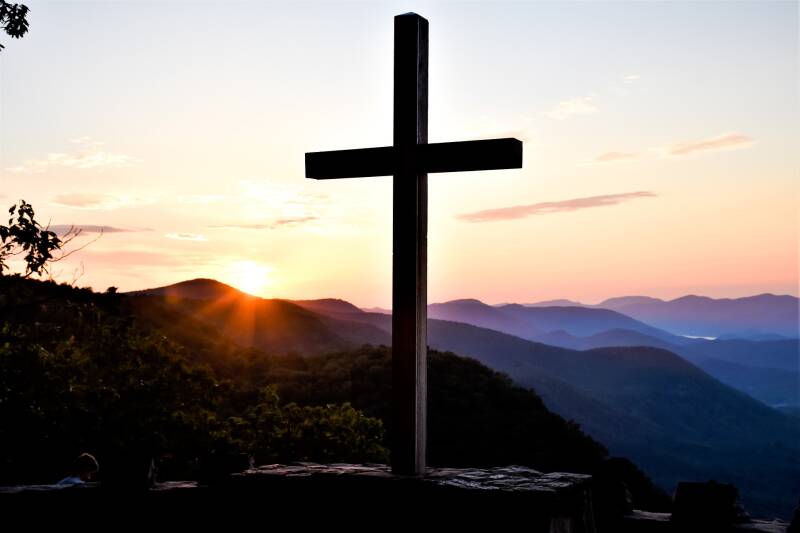
So, going back to the conversation, someone had to pay to fill this empty space, or cross, in our case. All of this was done to restore the balance.
That’s why the Son of God came. To die for us, for those who believe, so that we don’t have to pay. God had mercy. Someone still had to pay and die because this was necessary to accomplish this work and establish justice. God couldn’t just forget about the sin we committed, even if He wanted to. Yet in His love, He did something about it. The best He could. He compromised Himself by deciding to suffer that punishment. This is amazing love!
God could’ve also just let us pay for our sins, and all would have been right before Him. He doesn’t have anyone to be accountable to or answer to. If we paid for our sins, justice would be rightly established. What He did instead was still righteous and just, but with the only difference that He paid instead of us. Sometimes we just don’t realize the grace we have; the opportunity, and it will be difficult to realize all of it in this life. Even if we are safe and reborn. Then we will just have a small part of the whole picture. That is, of course, good enough and can make us grateful. Our human mind cannot fully comprehend what He has done, but if we try to understand it through human imagination, we can say that God had a choice about who could have paid for the wrong—us or Him. Yet, He decided by His mercy to take the punishment upon Himself. What He didn’t have a choice in was the justice that had to be established about the sins committed. Someone definitely had to pay. The fact that He sent His Son proves it.
Sometimes we even dare to rebel or grumble in our hearts. May God forgive us and reveal more of His grace and of what He has done for us. And I am saying this to believers as well. We need to know that what He did was purely out of love, because even if He had wiped us out, it would still have been right; it would have been just. But He didn’t. This is where His compassion is manifested, in His desire to give us another opportunity.
He could have wiped everything out, but instead, He sent His Son. He took the punishment that justice required because, by nature, every sin demands payment, and justice must be served. His justice and judgment, in this case, can be understood as an almost natural response and reaction, because this is obviously rooted in His nature. Everything works this way.
Because of His Son, God does not react to us or deal with us according to what we deserve, because He dealt that way toward His Son on the cross.
For some, God does not deal with them according to judgment because they have already accepted and believed in His Son. For others, it is because He is giving them time to repent. And all of this is because of His Son. Do you remember the parable of the barren fig tree?
6 He also spoke this parable: “A certain man had a fig tree planted in his vineyard, and he came seeking fruit on it and found none. 7 Then he said to the keeper of his vineyard, ‘Look, for three years I have come seeking fruit on this fig tree and find none. Cut it down; why does it use up the ground?’ 8 But he answered and said to him, ‘Sir, let it alone this year also, until I dig around it and fertilize it. 9 And if it bears fruit, well. But if not, after that you can cut it down.’ ” (Luke 13:6-9)
Well, this parable applies to us. We have been given an opportunity, a time to accept Him. That is why the Son is so important. That is why believers are called Christians, and that is why the Bible is so focused on Him. Because if we are alive today, it is because of Him. We can compare the vineyard owner to God the Father and the keeper of the vineyard to the Son. The fact that he listened to the vineyard keeper’s advice shows that the Father and the Son are perfectly united in will and purpose. They are one in divine nature, yet they reveal different aspects of God’s character in this situation. The Son reveals mercy, and He came to earth to bring about the mercy and opportunity that God wanted to give to humanity.
This is the one year, which is only symbolic, given to the tree to show whether it will bear fruit after receiving special care. This special care is given by the Son. The vineyard owner represents God the Father and His ultimate justice, which will be revealed one day.
We can see how this parable partly reflects and confirms the doctrine of the Trinity and the relationship between the Father and the Son within it. We can see how they work in perfect harmony, and both are exalted. The doctrine of the Trinity exalts all three Persons—the Father, the Son, and the Holy Spirit—because they are one God, and have the same purpose.
We can see the natural response of God expressed in His judgment, but also His mercy, giving us an opportunity. Yet His judgment always comes, even if delayed, if a person does not accept the opportunity given through the sacrifice of the Son. Remember that He is not only extremely great—even calling Him great is too little—but He is over everything and sustains everything. There is no room for argument regarding His authority.
24 God, who made the world and everything in it, since He is Lord of heaven and earth, does not dwell in temples made with hands. 25 Nor is He worshiped with men’s hands, as though He needed anything, since He gives to all life, breath, and all things. 26 And He has made from one blood every nation of men to dwell on all the face of the earth, and has determined their preappointed times and the boundaries of their dwellings, 27 so that they should seek the Lord, in the hope that they might grope for Him and find Him, though He is not far from each one of us; 28 for in Him we live and move and have our being, as also some of your own poets have said, ‘For we are also His offspring.’ (Acts 17:24-28)
Many evolutionists throughout time have attributed the natural reactions and development of things in nature to evolution, without realizing that there is intelligence behind them and that God stands behind them. Of course, natural elements really do react under certain conditions. But to me, this does not prove evolution; rather, it shows that there is a greater mind behind all the variations and behind the way everything works in nature—and that is God. God works in this way. Just as different elements and things in nature react in a certain way under certain conditions because God created them to function that way, God also responds to sin according to His nature. It is because of His nature. He is holy, and He cannot act otherwise. If everything is in disorder in this world, it is because of people and because He does not fully interfere yet. He does not do that because He wants to give us an opportunity.
And we cannot oppose Him or the way He wants things to be. Apart from Him, we are nothing; we cannot make it. It is like a fish opposing water or a bird opposing the air. In the same way, we were created for Him. We can only survive now, and we still carry on, because we are covered by the shelter of this time of grace. But this time is running out. And we need to respond to what we are called to and to what we were created for—to worship Him, first receiving Him in our hearts. There is much to be thankful for, especially when speaking about this topic. We hope and pray that God will show us and help us understand His sacrifice more clearly.


Add comment
Comments